



Saturday, Jun 30, 2012 Mosaic Project – Part 1
 When people walk into our studio, they always comment about how beautiful it is inside and how they had no idea that all of this style and warmth was back here. Other than our iconic lighted arches in the front windows, the façade of our building doesn’t have much to recommend it and gives little clue to the inviting spaces within.
One of our students, Lisbeth Ohmer, is a talented mosaic artist. You may have seen her work across the street at Los Toros. She saw the plain cement shelf beneath our front windows and envisioned it covered with tiles and jewels. Lisbeth works primarily on commission and has no plan in advance. Once she meets the client and sees the space, inspiration begins to flow.
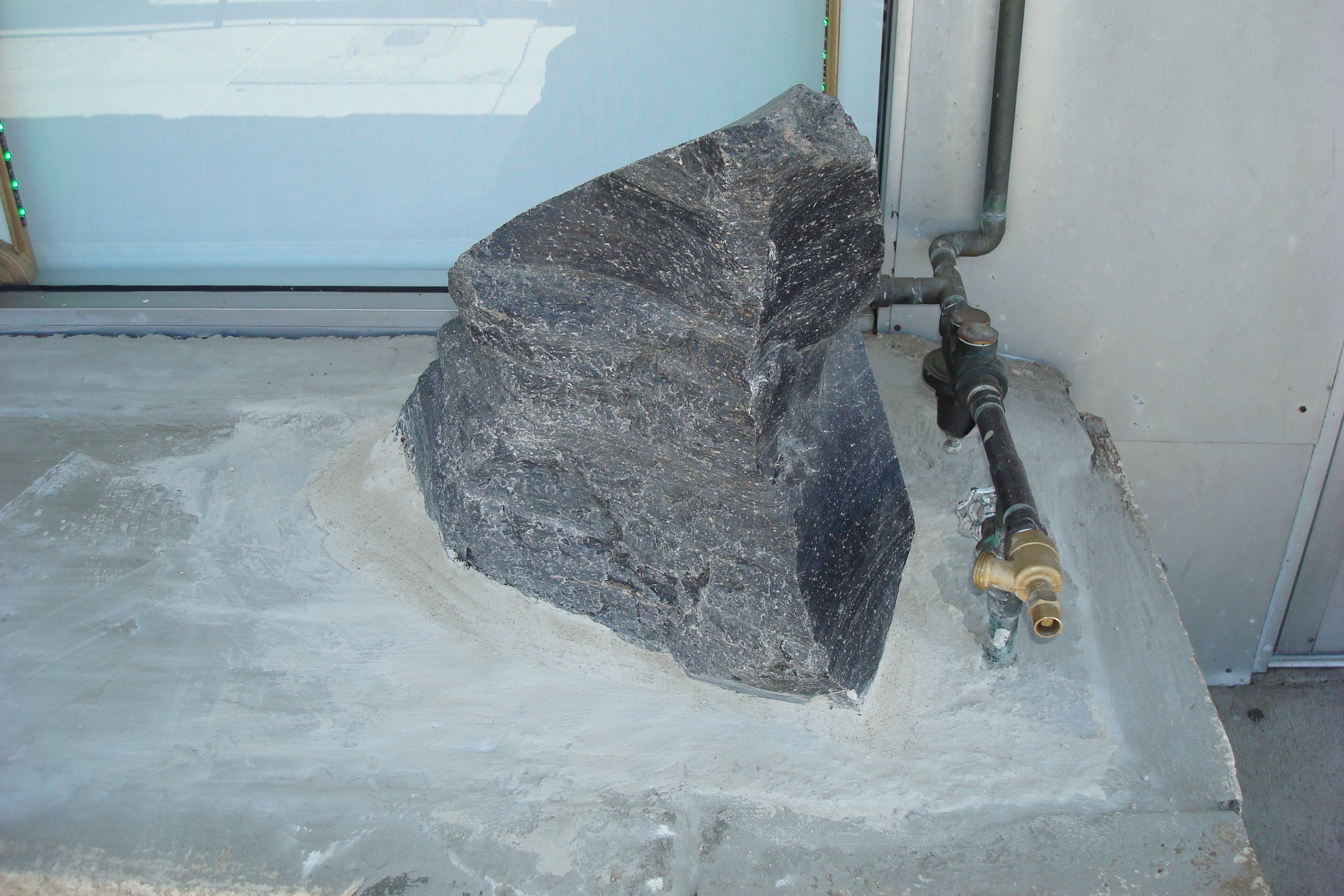
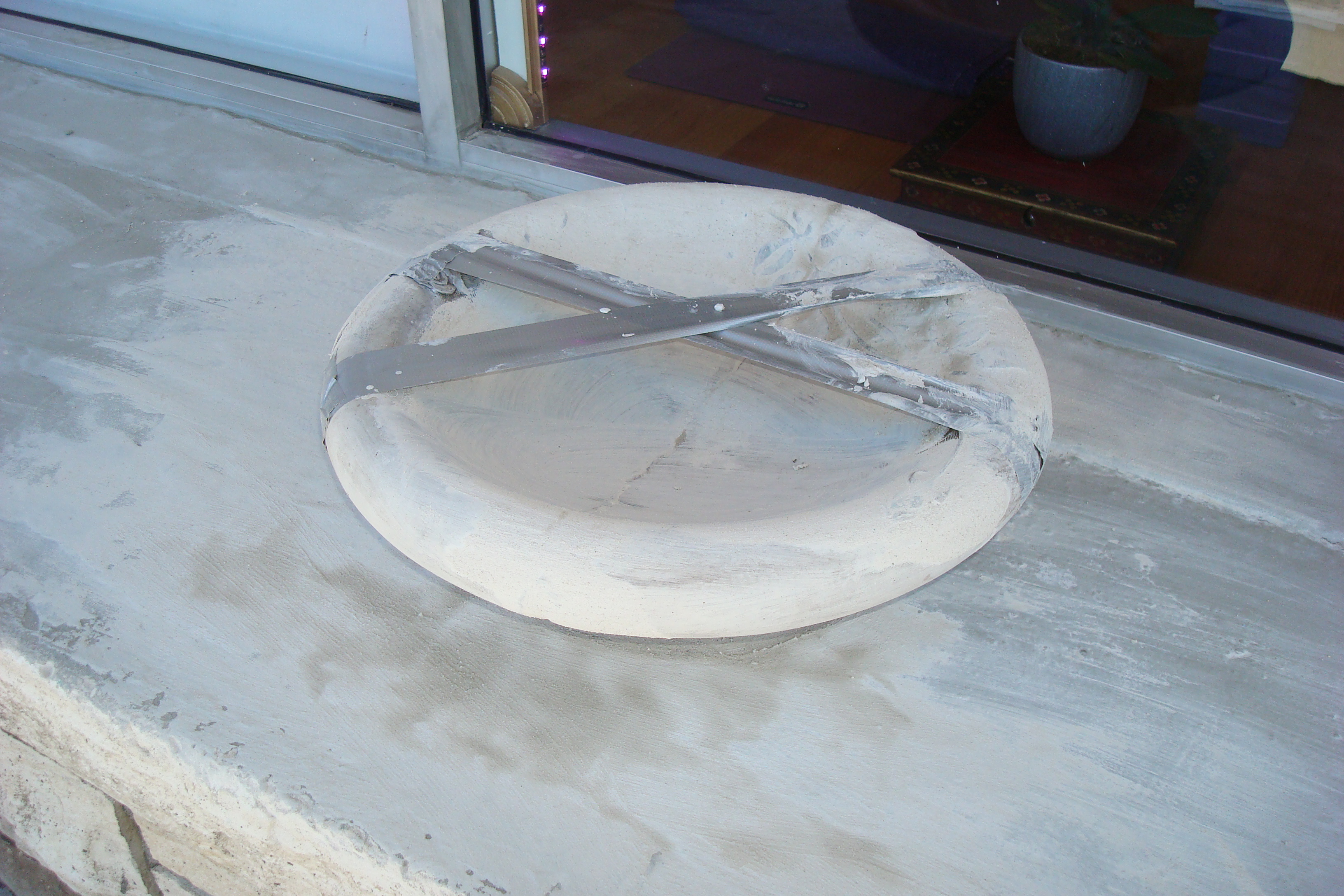
 The first day that Lisbeth started work on the studio, she brought a huge black rock that she’d had for a while just waiting for the perfect project. She thought it would be a great way to camouflage the exposed water spigot near our front door. I thought it looked like the Rock of Gibraltar and didn’t really see where she was going with it. Soon, she brought a weathered urn and a broken birdbath to anchor the left and center of the ledge, respectively. I couldn’t see her vision and wasn’t sure where this was headed, but the next time she came to work, the magic began to take shape…
Continue to Part 2.
posted by Kirsten K.
Friday, Jun 08, 2012 Synchronicity
Marydale has a green hybrid SUV with the license plate BGRNOW (Be Green Now). Today, she was out running errands and pulled into a parking space to find that she was nose-to-nose with another green car sporting the license plate BGRN NOW. Normally, I would say, “What is the chance?!”, but this sort of thing is par for the course with Marydale.

Friday, May 04, 2012 Favorite Things – New Products at Param Yoga
Our list of Favorite Things is expanding. We are now carrying a number of new products for sale at the studio that we hope will become your favorites too:
Tulsi
We recently blogged about the many benefits of the Tulsi plant. Since then, we have begun to offer Tulsi products for sale in the studio:
 Organic Tulsi Tea
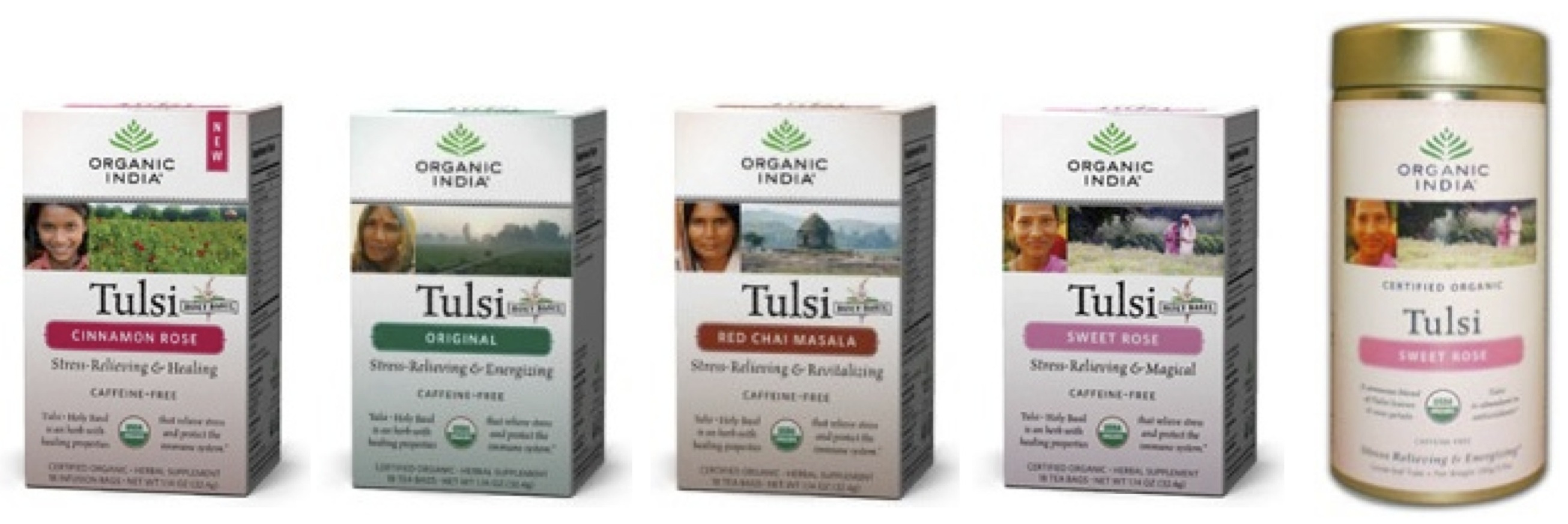
Marydale likes to serve Tulsi tea after our Yoga & Meditation classes, and our students love it! We now offer Marydale’s 4 favorite flavors: Cinnamon Rose, Original, Red Chai Masala, and Sweet Rose (bags and loose leaf tea canister). Tulsi is naturally caffeine-free, so you can enjoy it at any time of the day or night.
 Tulsi Mala Beads
Handmade from the stems of the organic Tulsi plant, these beads are believed to bring good fortune to the wearer. Each mala is composed of 108 beads (a symbol of living in harmony with nature) and comes in a silk drawstring bag.
 Tulsi Essential Oil
When inhaled, Tulsi essential oil is used to purify the mind. When applied topically, it makes an effective mosquito repellent and can soothe skin infections and acne. Massaged into the muscles and joints, Tulsi essential oil can provide relief from peripheral neuropathy and mild aches and pains. The oil has a sweet, fresh smell that reminds us at the studio of gumdrops!
(Note: Tulsi essential oil can be irritating to the skin. Always dilute in a carrier oil before applying externally.)
All of the Tulsi products we carry are organically grown by small family farmers in India.
Stop by the studio and discover the wonders of Tulsi for yourself!
The Elixir of Life
Chyawanprash
Chyawanprash (CHAI-en-prah-sh) has been called “The Elixir of Life”. It is a delicious jam made from an Ayurvedic recipe including wild forest fruits and 36 different herbs. It is high in antioxidants and vitamin C and contains adaptogens, which improve metabolism and boost immunity.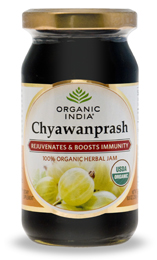
Some of the benefits of Chyawanprash include:
- Strengthens the digestive system
- Enhances memory recall and retention
- Improves complexion
- Promotes healthy hair growth
- Increases libido
- Supports liver, lung, and heart function
- Nourishes brain cells
The flavor of Chyawanprash has been described as sour, sweet, pungent, bitter, and astringent. It can be spread on bread or crackers, added to smoothies, or eaten straight from the jar. In India, it is traditionally stirred into a warm glass of milk.
Pick up a jar at the studio and make this remarkable superfood a part of your daily diet.
Light Up Your Life
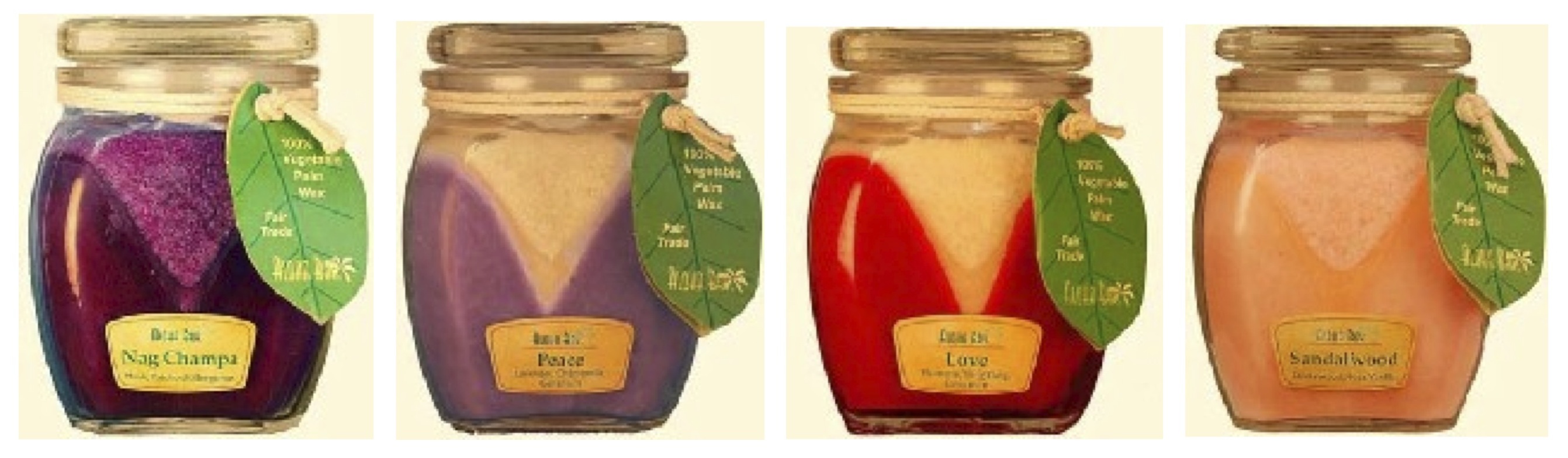 Richly Scented Jar Candles
Marydale bought herself a Nag Champa candle and fell in love with the scent, so she wanted to carry this intoxicating fragrance in the studio. We now offer the Nag Champa (musk, patchouli, bergamot), Peace (lavender, chamomile, geranium), Love (plumeria, ylang ylang, cinnamon), and Sandalwood (sandalwood, rose, vanilla) candles for sale. All are made from 100% vegetable palm wax and come in a sturdy glass jar with a lid. These richly scented candles burn for 70 hours.
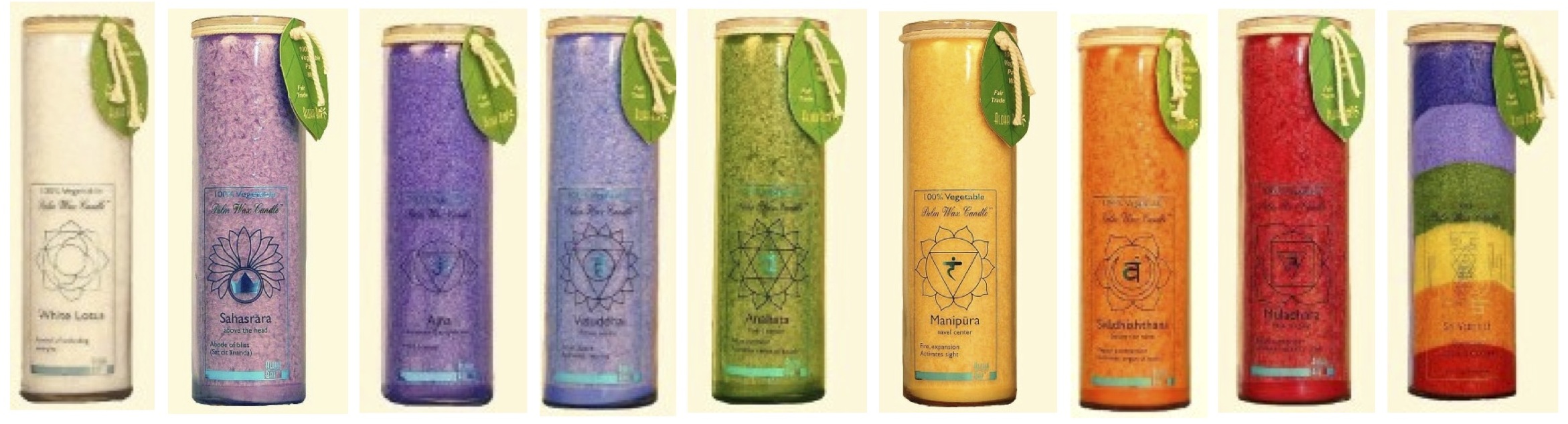 Chakra Jar Candles
Burning a candle or candles during your meditation or yoga practice can enhance the experience. These chakra candles help you to focus your energies on a particular area by representing the colors and the spirit of each chakra, from the root all the way to the crown. The rainbow candle contains the colors of all the chakras and has proven to be very popular at the studio. These 100% vegetable palm wax candles are unscented and burn for 100 hours.
The next time you’re at the studio, browse our selection of candles and enjoy the beautiful aromas and colors.
Friday, Apr 06, 2012 Favorite Things – Tulsi
Tulsi, or “holy basil”, is one of the most revered herbs in India. It is used in Ayurveda to strengthen the immune system and is an important symbol in Hindu religious tradition. The best way to obtain the benefits of Tulsi is by drinking it as a tea, which we often enjoy at Param Yoga at the end of our Yoga & Meditation class.
Some of the reputed benefits of Tulsi:
- Acts as a nerve tonic.
- Believed to sharpen memory.
- Brings down fever.
- Eases effects of the common cold.
- Promotes removal of mucus from the bronchial tubes.
- Relieves sore throat.
- Strengthens the kidneys and assists in removal of stones.
- Reduces level of blood cholesterol.
- Acts as an adaptogen to prevent and relieve stress.
- Soothes ulcers in the mouth.
- Acts as a curative for insect bites.
- Relieves headache pain.
- And more…
To read more about Tulsi and purchase the tea, visit Organic India.
Click here to watch some short videos on The Power of Tulsi.
Sunday, Apr 01, 2012 Read of the Month: The Yoga Sutras of Patanjali

Thursday, Mar 15, 2012 Yoga is NOT a competition
Well, technically yoga IS a competition if you’re entering the National Yoga Asana Championship or you are one of the people campaigning to make yoga an Olympic event. However, competitiveness is the antithesis of traditional yoga.
Yoga is all about being in the moment and doing just what you can do right now. Marydale is always telling her students: “Go to your edge, but never to pain.” She encourages us to close our eyes, focusing only on the body and breath, and to go at our own pace.
There is a full wall of mirrors in our yoga studio, but we usually face away from it during class. Mirrors encourage comparison with others and criticism of ourselves, when we should really be focusing within on how the position feels, making adjustments accordingly. Some students are aware that they should not compare themselves to others in class, since everyone has a different body and is at a different place on their yoga journey, but we are often competitive with ourselves.
I am not very flexible and had hoped that I would become more flexible with yoga. I know that yoga is not goal-oriented or a competition, but after more than a year of going to class three times per week, I find myself constantly taking stock. When I began, I couldn’t touch my toes. I would bend at the waist and reach down as far as I could before the pain in my tight-as-a-drum hamstrings stopped me with my fingers about a foot from the ground. Now, by the end of a vigorous yoga class, I can get those fingers almost an inch from my toes. This should thrill me, but I feel like it’s not good enough.
Recently, we were doing a position in class that is very difficult for me. My body simply won’t move that way. Whenever we do it, I struggle to get into the position as best I can, remembering intermittently to breathe, then remain in my awkward version of the pose for as long as I can, hoping that nobody is looking at me. I brought this up to Marydale at the end of class, wondering about the purpose of struggling to get into this pose when I am clearly not achieving the intended benefit.
This led to the familiar discussion of how yoga meets you where you are and how even the most advanced yogis have days when they are less flexible than others. But Marydale expanded on this to say that true yoga was originally intended to be taught one-on-one, directly from teacher to student. This way, yoga can be perfectly tailored to your body, your needs, and your limitations. Since, for most people, individual yoga classes are expensive and impractical, we usually find ourselves in a group class. The takeaway: do what feels right to you.
I have a long torso and short legs. As a result, I can’t even do child pose—a pose so simple, yes, even a child can do it. If I were to assume this pose “correctly”, I would topple forward onto my face. So, I modify it. While the majority of students rest in the pose with their arms at their sides, I support my forehead on my stacked, closed fists. There are endless modifications that can be made, but if a pose is simply beyond your capability, choose another pose. Better yet, ask the teacher for a modification or a comparable pose. Speak up for yourself. Marydale likes to say, “This is YOUR yoga.” Make it yours and don’t worry about what anyone else thinks, least of all that little voice of self-criticism that says you’re not doing it right.
Instead, I hear Marydale’s voice like a mantra: “Stay in the moment. Close your eyes. Breathe. Feel the position. Move at your own pace. Go to your edge, but never to pain.” And, more importantly, “Why are we smiling? Because we LOVE OUR YOGA!”
posted by Kirsten K.
Friday, Mar 09, 2012 Did yoga really start as a sex cult?
There has been a flurry of responses online to William J. Broad’s article in the New York Times titled Yoga and Sex Scandals: No Surprise Here. Articles by yoga teachers, students, and bloggers have ranged from angry accusations of reductionism to calls for understanding and compassion for the individuals involved. But is one of the main assertions in the article actually correct? Did yoga really start as a sex cult? Yoga educator Leslie Kaminoff addresses the issue nicely in this brief video:
Monday, Feb 20, 2012 Jewelry-Making Workshop
 We want to thank Hannah-Childe for another wonderful Jewelry-Making Workshop this past Saturday at Param Yoga. As with the workshop she led for us in November, there was an abundance of creativity and laughter among the group. Hannah was very patient with everyone, teaching the basics of making beautiful jewelry and encouraging participants to let their imaginations run wild. Each person left the workshop with one of her own creations, be it a bracelet, necklace, or pendant. It is extremely satisfying to fashion and wear your own jewelry, knowing that it truly represents you and expresses your unique character. Thanks again, Hannah, for encouraging all of us to free the artist within.
To learn more about Hannah and the jewelry creations she makes and sells through her company HannahMade, click here.
Friday, Feb 10, 2012 Spiritual History of Los Angeles
 When he first arrived on the West Coast in 1925, Paramahansa Yogananda called Los Angeles “the Benares of America.” L.A. reminded him of India’s holiest city because a certain spiritual energy permeated the hot, dry air. He may have sensed that the growing town was destined to become the prime relay station for the processing and distribution of Yogic teachings.
Yogananda himself, of course, played a principal role in that history. After making a 12-acre site atop Mount Washington the international headquarters of his Self-Realization Fellowship, he became “the 20th century’s first superstar guru,” to quote the LA Times. Over the years, Yogananda’s visible footprint was placed on other choice properties in the region, notably the magnificent Lake Shrine on Sunset in Pacific Palisades and the cliff top retreat in Encinitas, where he wrote his iconic memoir, Autobiography of a Yogi.
More than two decades before Yogananda made L.A. his home, Swami Vivekananda ushered in the 20th century in this part of the world. During his three-month visit commencing in December of 1899, lecture halls were filled with crowds eager to hear the triumphant star of the 1893 World’s Parliament of Religions speak on subjects like “The Science of Yoga.” In 1923, one of his devotees, Swami Paramananda, founded Ananda Ashrama, a still-functioning sanctuary in the hills of La Crescenta. A few years later, the triple-domed temple of the Vedanta Society rose up in Hollywood. There, in the 40s and 50s, a trio of celebrated authors, Gerald Heard, Christopher Isherwood and Aldous Huxley, were schooled in Vedanta philosophy and Yogic practices by the erudite Swami Prabhavananda, who presided over the temple from 1929 until his death in 1976 at the age of 82. The essays, novels and nonfiction books (e.g., Huxley’s seminal The Perennial Philosophy) produced by those literary lions educated millions about India’s spiritual treasures. Prabhavananda and Isherwood teamed up on elegant translations of the Bhagavad Gita and the Yoga Sutras (titled How to Know God) that were the best-read versions of those classics for years. The Hollywood center remains a custodian of Vivekananda’s vision of adapting the ancient dharma to the modern West.
The other Hollywood—the star-making industry, as opposed to the geographical entity—has also played a major role in beaming Yoga and Indian philosophy to the masses. As early as the 1930s, celebrities such as Charlie Chaplin and Greta Garbo would motor up to Ojai in their roadsters to listen to the pathless pathfinder, Jiddu Krishnamurti. It was in Ojai that the iconoclastic Krishnamurti had the spiritual breakthrough that led him to reject the messiah-like role for which he’d been groomed by the Theosophists who brought him to the West as a teenager. For nearly six decades, his spring lecture series drew thousands of Angelenos to Ojai annually.
Hollywood star power also taught folks in the hinterlands about Hatha Yoga. Celebs like Mae West and Greta Garbo were linked to the practice early on, and in the 1950s gossip columnists reported that icons such as Gary Cooper, Marlon Brando, and Marilyn Monroe were into it. Marilyn was said to do asanas “to improve her legs,” proving that Yoga as physical fitness did not begin in the Madonna era. One of the teachers of celebrities and thousands of others was Indra Devi, the so-called First Lady of Yoga, whose landmark book, Forever Young, Forever Healthy, coupled with numerous public appearances, helped bring the teachings to the masses. Born in Eastern Europe, she was a student of the legendary Hatha revivalist Tirumalai Krishnamacharya. Only an exceptional woman could have broken through India’s male-only Yoga club back then, and Indra Devi remained exceptional until her death in 2002 at the age of 102.
Among the region’s other mid-century Hatha teachers was Bishnu Charan Ghosh, Yogananda’s younger brother. One of his students was Bikram Choudhury, who went on to build a worldwide empire with his trademark high-temperature Yoga. Another innovator in L.A. at the time was Richard Hittleman. A devotee of the non-dualist saint Ramana Maharshi, Hittleman penned enormously popular books and pioneered the use of video. His daily TV show, “Yoga for Health,” debuted in L.A. in 1961 and was syndicated nationally for years.
In 1953, Judith Tyberg, a direct disciple of Sri Aurobindo, one of the spiritual giants of modern India, founded the East-West Cultural Center near the intersection of Beverly and Vermont. The center moved several times before settling into its present location in Culver City in 1985. A native San Diegan who studied Sanskrit in Benares, Dr. Tyberg introduced Angelenos to Sri Aurobindo’s work and hosted visiting teachers who went on to have a huge impact on modern Yoga. Among them was Swami Vishnudevananda, who was sent to America in 1957 by his guru, Swami Sivananda of Rishikesh. Ganga White, one of many seekers who found their way to East-West in the sixties, trained with Vishnudevananda and later opened the Sivananda Center for Yoga on Sunset and Western during the apex of flower power. The Hare Krishna devotees added to the colorful atmosphere of the era, giving locals their first glimpse of traditional Hindu Bhakti and their first earful of Sanskrit chanting, a precursor to today’s kirtan scene. They would soon establish an L.A. temple (now in Culver City) and, in 1977, start their annual Festival of Chariots in Venice.
In the seventies, White disconnected from the Sivananda lineage and turned The Center for Yoga into a prototype of today’s independent studio. It offered an eclectic menu of classes and hosted a parade of luminaries, from Swami Satchidananda to Allen Ginsberg to the first teachers trained by the influential Hatha masters B.K.S. Iyengar and Pattabhi Jois (Iyengar himself lectured there in 1976, as did Pattabhi Jois in 1985). The center caught on quickly, forcing a move to a larger location on Larchmont Boulevard, which is now owned by YogaWorks. White went on to found the White Lotus Foundation in Santa Barbara, and Swami Vishnudevananda’s lineage was reestablished as the Sivananda Yoga Vedanta Center, which is now located in Marina Del Rey.
The watershed moment in the West’s embrace of India’s spiritual heritage came when the Beatles met Maharishi Mahesh Yogi, studied his Transcendental Meditation (TM) and, in early 1968, famously retreated to the banks of the Ganges River. Overnight, words like mantra, guru, and ashram entered the collective vocabulary, and it became acceptable, even fashionable, to start the day in silent meditation. The locus of that phenomenon was London, but the sparks were lit years earlier in L.A. when clean-cut citizens of Ozzie and Harriet’s America were drawn to the Maharishi. When college students looking for ways to expand their awareness without dangerous drugs turned to TM, the Students International Meditation Society (SIMS) was created at UCLA. By 1966, SIMS had branches at several major campuses, and after the Beatles’ media explosion its office on Gayley Avenue became the administrative engine of a massive movement. One of the UCLA meditators, Keith Wallace, wrote his doctoral dissertation on the physiology of TM, and his findings, published in 1970, would jumpstart a research juggernaut that moved meditation into the mainstream.
The chain reaction that led directly to the Beatles began with an L.A. record producer named Richard Bock. The head of World Pacific Records, Bock started promoting the music of Ravi Shankar soon after the great sitarist’s first visit to the West in 1956. He produced some of Shankar’s early albums and connected him to L.A. based jazz artists like flutist Paul Horn, who became one of the first American TM teachers and later recorded the seminal “Inside the Taj Mahal” album. Bock also introduced Shankar to John Coltrane, who infused his music with Indian sounds and themes, and to Alice Coltrane, who went on to become a Swami with an ashram of her own in the Malibu hills. It was also through Bock that David Crosby, then a member of the Byrds, first heard Shankar’s music. Crosby shared his discovery with George Harrison in 1965, at a Benedict Canyon party. The rest is musical and spiritual history. While studying sitar with Shankar in India, the quiet Beatle’s spiritual longing found direction, and his path led to the historic Beatles-in-India moment.
Once the floodgates were opened, L.A. continued to be the principal conduit for the East-to-West transmission. Yogi Bhajan, who first appeared at the East-West Cultural Center in 1969, started teaching his distinctive Kundalini Yoga on Melrose Ave, down the road from the Bodhi Tree, which in 1970 established itself as the prototype for spiritual bookstores everywhere. Also starting up in a Melrose storefront (circa 1972) was the American guru who was born Franklin Jones, became Bubba Free John and, after more name changes, passed away as Adi Da Samraj.
Virtually every teacher whose impact reverberated nationally made important inroads in Los Angeles. Swami Muktananda, for instance, introduced his Siddha Yoga to Angelenos during his three world tours, beginning in 1970. On his first visit, he was accompanied by Ram Dass, who was then in the early stages of his indispensible life as the spiritual teacher formerly known as Harvard psychologist Richard Alpert. Mutkananda spent six months in L.A. on his third tour, holding public events in a huge tent in Santa Monica, where the Loews Hotel now stands. His successor, Swami Chidvilasananda (Gurumayi), also came to Los Angeles a number of times in the eighties and nineties. And, as local Yogis know, B.K.S. Iyengar and Pattabhi Jois, the progenitors of the asana-based practice now virtually synonymous with the word Yoga, established a powerful L.A. presence. The transmission continued through the turn of the century, as new teachers—Sri Sri Ravi Shankar, Mata Amritanandamayi, Sri Karunamayi, Sadhguru Jaggi Vasudev, and others—have found some of their most welcoming audiences in L.A.
Somehow, a city known for glitz and glamour also acquired a strong ethos of inner development. In what other city could Bhakti Fest, Yoga Month or Yoga therapy have been incubated? Where else could professor Christopher Chapple create a Yoga Studies program at the Jesuit-run Loyola Marymount University? Los Angeles has probably produced more Yoga teachers per capita than anywhere else in the country, and must surely lead the nation in the number of asanas performed and mantras intoned per day. By all indications, the Benares of America will continue to beam Yoga in all its forms as skillfully as it beams movies and TV shows.
Philip Goldberg, the author of American Veda: From Emerson and the Beatles to Yoga and Meditation, How Indian Spirituality Changed the West, is leading a workshop at Loyola Marymount’s Yoga Studies program on October 15th (www.AmericanVeda.com).
Courtesy of LA Yoga Online.
Friday, Jan 27, 2012 Yoga & Meditation Class
 We’ve only been offering our De-Stress with Yoga & Meditation class for about two months, but it’s already become our most popular class. The class combines asanas with a different meditation technique each week. Thus far, we’ve explored sitting in lotus, walking meditation, using the crystal bowl to open the third eye, and staring at a candle flame. Afterwards, we share our experiences over tea.
Marydale always stresses that the true purpose of yoga is to prepare the body to sit in meditation. Exploring the various meditation techniques following our asana practice has shown us how much easier it is to enter a meditative state after doing yoga. Students have reported deeper and more profound meditations in the class than they’ve ever had before.
Due to the popularity of this class, we’ve decided to add another De-Stress with Yoga & Meditation class to our schedule on Monday nights from 7:00-8:30 pm. This class will replace the former Daily Practice class from 7:00-8:15 pm (Yoga & Meditation is a slightly longer class). We hope you’ll join us in one or both of these classes to strengthen your body, de-stress, and connect with your inner guidance. Namaste.